
Latinas Transforming Sports Media
By Gloria Romano-Barrera
For generations, soccer has united Latino communities through passion, culture, and pride. Today, women like Carlota Vizmanos and Adriana Monsalve are redefining who gets to tell those stories on the world’s biggest stage. As leading voices at Telemundo Deportes ahead of the historic 2026 FIFA World Cup, both women are breaking barriers in sports media while staying deeply connected to their roots, their families, and the communities that shaped them. Their journeys reflect more than career success; they represent resilience, representation, and the growing power of Latina voices in global sports.

Carlota Vizmanos Studio Host Telemundo Deportes
“When I was a child, I always loved soccer,” shares Carlota Vizmanos, Studio Host for all Telemundo Deportes coverage. “But I never, when I was a child, thought about working in football, in soccer.”
When Vizmanos was a little girl growing up in Spain, soccer was everywhere, but women weren’t. She loved the game, yet the idea of building a career around it never even crossed her mind.
Today, she sits at the heart of one of the most powerful stages in global sports, the World Cup. As a host for Telemundo Deportes, Vizmanos is living the dream she once thought was out of reach.
“The World Cup is the most incredible moment,” she shares. “We are waiting for those last four years. For us, it’s the most important moment of our careers.”
Growing up in Spain, soccer was a way of life, but not always a space for women. Vizmanos played basketball, tennis, and swam as a child, but never soccer. It wasn’t until much later, when a sports outlet in Spain called her and
invited her to try working in soccer, that she realized this path could be hers.
That one invitation opened a door, not just for her, but for all the young
women watching.
For Vizmanos, visibility is everything. She knows firsthand how life-changing it can be to finally see someone who looks like you in the role you dream about.
“It’s so important to have women here that you can see on the TV speaking about football, sitting at the same table as a lot of men in the same position,” she shares. “We have a huge team of women working in sports in front of the camera and behind the camera.”
At Telemundo Deportes, she is no longer the exception. She is part of a powerful community of women reshaping sports media from the inside out. Where once it was difficult even to find a single Latina to feature, there is now an explosion of talent, presence, and voice.
Vizmanos is not only covering the biggest stages in men’s soccer; she is also part of a movement transforming how the world sees women’s sports.
“In Telemundo, we have a huge team of women working in sports, in front of the camera and behind the camera,” she shares. “Telemundo always supports women’s sports. Everything has changed a lot in only four years. People are so much more connected with women’s sport. The most important thing is the support of the media to put women’s sports on the front page.”
Vizmanos understands that visibility is opportunity, that when matches are aired on national television and women athletes are given equal space, dreams become possibilities for the next generation.
Vizmanos’ work is deeply rooted in her Latino heritage. Her identity is not an accessory to her career; it is its foundation. In a world that often focuses on ratings, clicks, and numbers, she finds meaning in something much more human, it’s joy.
“Sports is joy, it’s happiness for people,” she shares. “You have the opportunity to connect with people in that way. I think today, good news is so important to communicate good things and have the opportunity to bring happiness to people.”
For her, every match she covers is a chance to help someone forget their problems for a moment and simply feel.
“You can disconnect from your normal life, from your problems, from everything, and for a moment be happy watching your team win an important game,” she shares. “That’s so beautiful.”
In an industry that often measures success by followers, ratings, and fame, Vizmanos holds a very different definition.
“Success is sleeping well at night, being at peace with myself and with the things that I do,” she shares. “If at the end of the day I go to sleep and I think, ‘I did my best,’ that’s success for me. Doesn’t matter the audience, the likes that you have on social media, or the followers.”
For her, success is integrity, peace, and presence with family, especially with her four-year-old son, Leon.
“Being at peace with my family and staying with my kid. That’s success,” she shares.
Vizmanos’ journey is not without sacrifice. She is navigating motherhood and a demanding career far from her home country and family support system.
“It is the most difficult thing in my life, because I’m also not in my country,” she shares. “I don’t have my family here, everything is so different than Spain, so you need to start from the beginning, my work, the kid, the travels. It’s so hard for me.”
Vizmanos believes we are only at the beginning of what women and Latinas will achieve in sports. Looking ahead, she believes women’s sports and Latinas in sports are only getting stronger.
“In five years, things are going to change a lot. Everything is so different,” she shares. “Next year is going to be the Women’s World Cup in Brazil. I think it’s going to be the most important Women’s World Cup in history.”
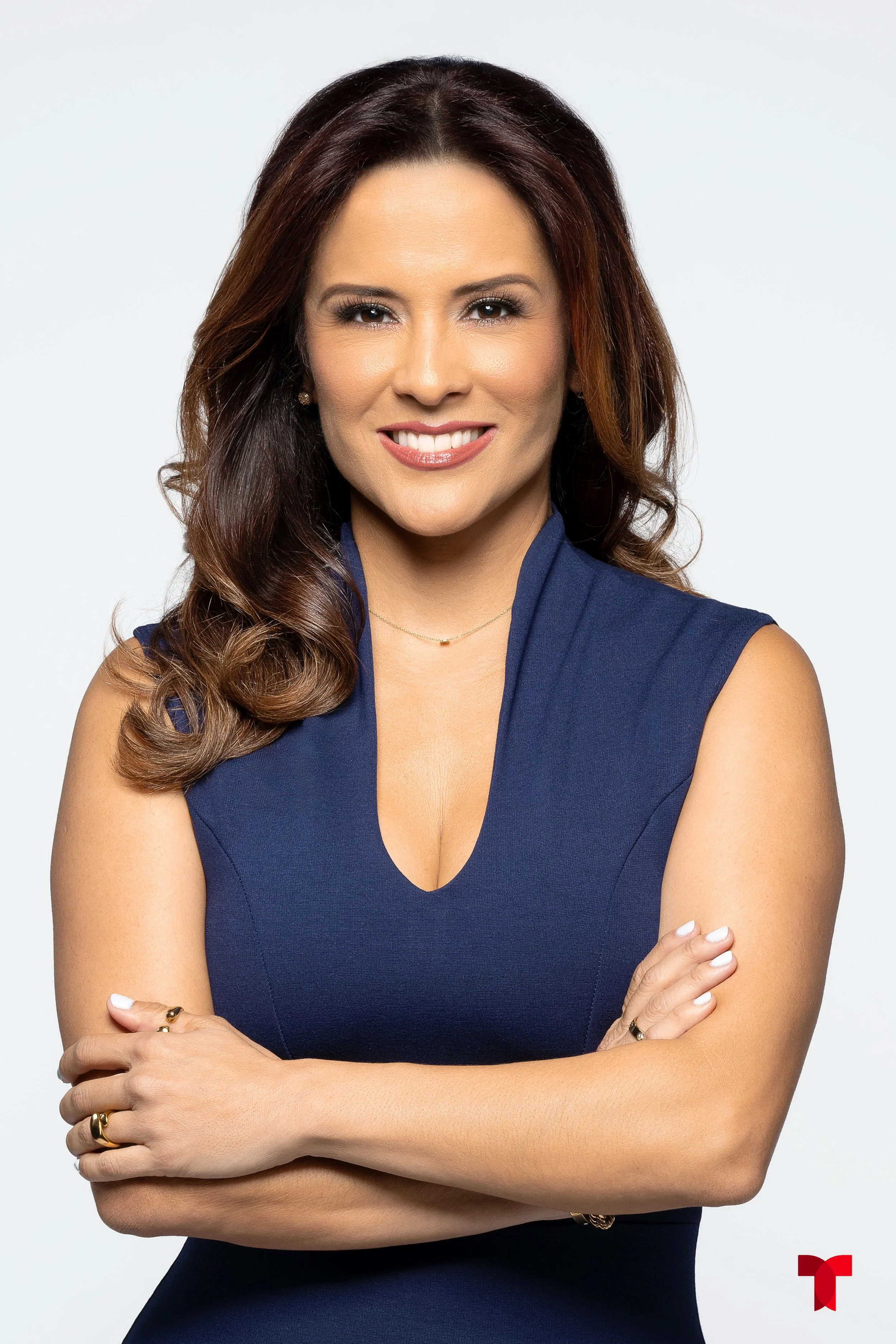
Adriana Monsalve Tournament Studio Host Sportscaster/Telemundo Deportes
When Sportscaster Adriana Monsalve talks about sports, her words carry more than analysis; they carry history, sacrifice, and the pride of an entire community. With over 20 years in broadcasting, Monsalve has become one of the most recognizable Latina voices in sports, now anchoring coverage for Telemundo as the world looks ahead to the 2026 FIFA World Cup.
From local TV in Orlando to the global stage, Monsalve has a World Cup written into her life. For Monsalve, the World Cup has never been just another assignment. It has been a guiding star so important that she planned her life around it, including having a baby.
“The first World Cup that I was going to be on site, it was Brazil 2014, and I knew that a year earlier with ESPN,” she shares. “I decided to get pregnant in 2012, so by the time that I was going to be in the World Cup, my baby would be a one-year-old.”
She didn’t just adapt to circumstances; she shaped them. Now, looking at 2026, her excitement is contagious. “I plan everything for the World Cup,” she shares. “I quit a job because I couldn’t go to the World Cup the way I wanted. And now this World Cup with Telemundo is the decision that really makes me feel that I did everything right.”
Montsalve highlights not only the scale, 48 countries, 104 matches, but also the emotion.“This World Cup has so many things that make it special,” she shares. “We’re gonna relate to our fans more than ever, especially for the Latino community. So it means a lot. It means culture, it means tradition, it means family.”
Montsalve has had opportunities to cross over into English-language broadcasting, but she made a deliberate choice to stay in Spanish.
“I have had opportunities to work in English, but working in Spanish is my passion, because it’s the language that I grew up with. It’s the language in which I really enjoyed the sports. Spanish is the passion. It is the language of passion and love, and it’s the language of football.”
For her, Spanish is not a limitation; it’s an advantage. Staying in Spanish means staying true to her community, her childhood, and the way she first fell in love with sports, watching baseball with her father in Venezuela. It is also a powerful statement in which, for Montsalve, success does not require abandoning one’s identity.
“Being a woman in sports, it’s still not a usual thing,” she shares. “Even though we have women in sports, you always have to demonstrate something, because you’re a woman.”
She doesn’t shy away from that pressure. She meets it with preparation and pride.
“It is really a commitment that I’ve had with Telemundo, being the host, being the face,” she shares. “It’s the first face that everybody is going to see before a match. I always try to be the best version of myself, so everybody can see that, and everybody wants to keep watching the World Cup with us.”
Her work is fueled by three pillars: passion, professionalism, and preparation. And her biggest reward is not just ratings or recognition, it’s impact.
“What I love the most about my career is when someone comes to me and tells me, ‘Hey, I want to work in sports and be a journalist because I saw you one day on TV.’ That legacy is really important for me,” she shares.
Monsalve carries her Latina identity not as a label, but as a source of power. She credits the women who came before her, her mother, her grandmothers, and the strong women in her community, for shaping her character.
“If I would want to live again and be born again, I would want to be Latina always,” she shares. “We have strong women, and we get that from our moms, our grandmas, our leaders. They always carry our culture, our tradition, the love for our family, the love to fight for what we want.”
For Monsalve, one word defines the Latino experience, especially in the U.S.: resilience. And at the heart of that resilience is her mother, the person who inspired her the most: “My mom taught me that everything was possible for me if I worked really hard to get it,” she shares. “She helped me to have really good self-esteem, have mental health, and understand that the most valuable person in my life should be me.”